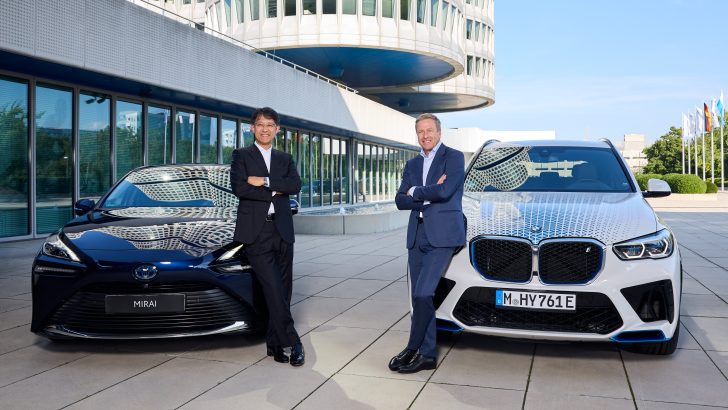
The BMW Group and Toyota Motor Corporation have joined forces on a major project. They will work together to develop a hydrogen fuel-cell powertrain.
According to the announcement, the collaboration will impact the future of both BMW and Toyota. The two companies will share information as they develop the powertrain for passenger vehicles and commercial fleets.
BMW will release the first vehicle featuring the hydrogen fuel-cell powertrain in 2028. The auto manufacturer did not provide details about the vehicle other than saying that it is part of the existing portfolio.
The hydrogen fuel-cell variant will be an option for one of its vehicles. It will join battery-powered vehicles, hybrids, and vehicles with internal combustion engines.
Both BMW and Toyota plan on releasing FCEV models in the coming years, which will be unique to each company. However, collaborating on this development helps “drive down the costs of fuel cell technology.”
“We are pleased that the collaboration between BMW and Toyota has entered a new stage,” said Koji Sato, President and Member of the Board of Management of Toyota Motor Corporation.
“In our long history of partnership, we have confirmed that BMW and Toyota share the same passion for cars and belief in ‘technology openness’ and a ‘multi-pathway’ approach to carbon neutrality. Based on these shared values, we will deepen our collaboration in efforts such as the joint development of next-generation fuel cell systems and the expansion of infrastructure, aiming for the realization of a hydrogen society.
“We will accelerate our efforts together with BMW and partners across various industries to realize a future where hydrogen energy supports society.”
The hydrogen collaboration extends beyond vehicles
The BMW Group and Toyota Motor Corporation have shown their commitment to hydrogen as a potential powertrain option in future vehicles. However, developing the powertrain is not the only part of the collaboration.
Both companies have stated that they will support the expansion of both hydrogen refueling and battery electric vehicle charging infrastructure. They will create demand while also working with companies building facilities for hydrogen production, distribution, and refueling.
How this relates to the United States market remains undetermined. California has 55 hydrogen refueling stations, but the rest of the country only has four.
Work on the infrastructure would have to ramp up for the new hydrogen fuel-cell powertrain to become a truly viable option Stateside.